
Adam's Notes
Quebeccian Ladies // The Oldest Book // Epstein's Canada connections // Majority Report Guys

About Me | Instagram | Goodreads | Letterboxd
Quick recap: Trying something new here, in the manner of Adam Tooze’s Chartbook. For the next month or so I’m going to try to putting out shorter posts with links to interesting stuff I’ve been reading or thinking about. So, yes, it’s another content aggregator, but it’s justifiable given my superior taste and wide-ranging interests.
Let’s go.
On the reputation of ‘Quebeccian’ ladies in the 1860s:
Into the vortex of Quebeccian society I threw myself with all the generous ardor of youth, and was keenly alive to those charms which the Canadian ladies possess and use so fatally. It is a singular fact, for which I will not attempt to account, that in Quebeccian society one comes in contact with ladies only. Where the male element is I never could imagine. I never saw a civilian. There are no young men in Quebec; if there are any, we officers are not aware of it. I’ve often been anxious to see one, but never could make it out. Now, of these Canadian ladies I cannot trust myself to speak with calmness. An allusion to them will of itself be eloquent to every brother officer. I will simply remark that, at a time when the tendencies of the Canadians generally are a subject of interest both in England and America, and when it is a matter of doubt whether they lean to annexation or British connection, their fair young daughters show an unmistakable tendency not to one, but to both, and make two apparently incompatible principles really inseparable.
Source: https://www.gutenberg.org/ebooks/22013
Love the term Quebeccian. Like he was so close to coming up with Maoist Standard English. I stumbled on this passage because I had a guilty conscience about a tweet I posted a few weeks ago:
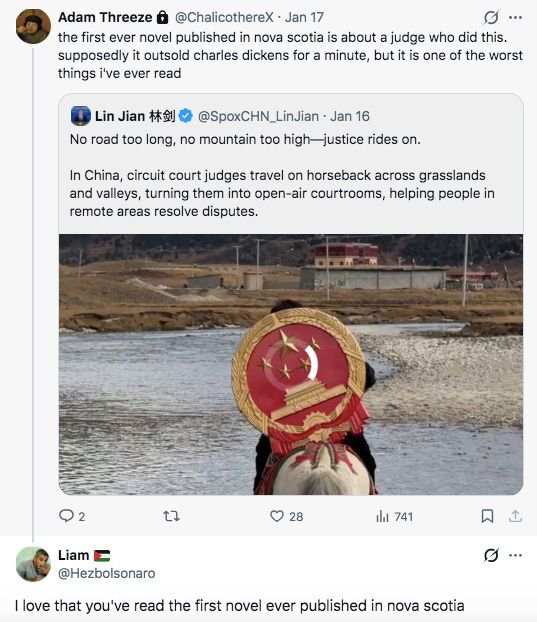
I’m pretty sure the book I’m referring to in my tweet (Thomas Chandler Haliburton’s The Clockmaker (1840)) is the first novel (or I guess fiction, as it’s really not a novel but a collection of sketches) published in Nova Scotia, but I could be wrong, so I went looking to see if there’s anything earlier. So far, no results. Demille’s The Lady of the Ice, excerpted above, wasn’t published until 1870.
The Clockmaker is really a terrible book, so it kind of sucks that it gets to be first. It has exactly one joke, which is that Maritimers are all lazy buffoons. It also uses the N word a lot because it’s racist as hell. The prose contains a lot of non-standardized spelling and is hard to read. I gave up about halfway through. Tim Bousquet wrote great review on his website a few years back:
In the end, Haliburton’s mean-spirit mischaracterization of Nova Scotians may have been too fully embraced by many Nova Scotians. Like Haliburton angling for a crown appointment to office, our present-day stuffed suits are all too happy to ridicule the backwards and lazy populace in order to advance their own self-entitled interests.
Source: The Halifax Examiner
A few excerpts from an interesting NYRB piece on raising chickens:
Then in the 1850s a craze called Hen Fever hit Boston. The city’s whaling fleet was bringing back from the South Seas colorful breeds of chickens that this hemisphere had never seen—Malays, Bengallers, and Chittaprats. … Fashionable Bostonians lived in houses with yards where they could keep the new exotics. Acquisitiveness set in. … Hen Fever spread to other cities, raising chickens in backyards caught on, and cities allowed it within their limits. When the fad died down, wandering chickens became associated with poor and immigrant city neighborhoods, where people kept them for the eggs. … People in the US did not eat much chicken—only about ten pounds per person a year—until 1940. During World War II, the government wanted red meat for the troops and rationed it for civilians, who were encouraged to eat chicken and eggs instead. By 1943 US consumption of chicken had risen to sixteen pounds a year, and it continued going up after the war.
…
One of the biggest moments in chicken history—maybe in history, period—came in the fall of 1983 with the introduction of the McNugget. … by 1992 chicken had surpassed beef as the most-consumed meat in the US. By 2023 Americans were eating about ten times more chicken than they’d eaten in 1940. Today chicken, most of it processed, is 45 percent of all the meat that Americans eat.
Source: "Bang the Drumstick Slowly”
Would’ve liked to see a bit more about factory farming, which is somewhat sidelined.
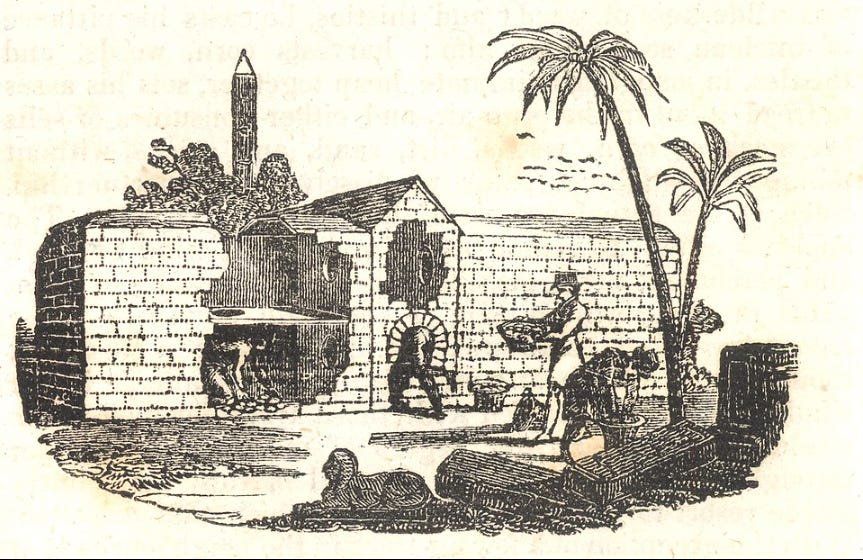
Reminded me of this piece from a few years ago about Egyptian egg ovens, which were brick ovens fuelled by burning animal dung, used to incubate thousands of chicken eggs at a time. They’ve been been around since ancient times and are still in use today.
I went a little bit manic over the weekend reading the latest Epstein document release. Apologies if I flooded your timeline on one of the other social media sites with excerpts.
I’ll leave it to the experts and more notable cranks to dig into the big picture stuff. My interest is more local. Epstein seems to have had a handful of connections to Alberta.
The one that interests me most is from someone at CBC News Edmonton. At one point the CBC person invited Epstein to a charity auction:
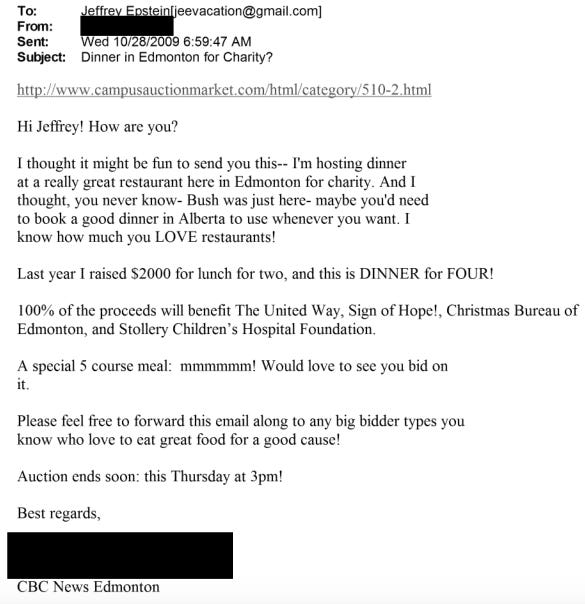
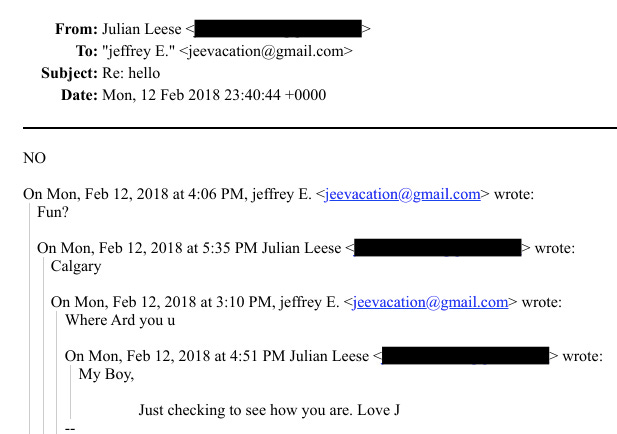
There’s also this earlier email exchange with someone from CBC Edmonton, which sounds like it’s the same person, probably an on-air personality, and the exchange takes places during Epstein’s first sentence, though it definitely seems like he’s out of prison at this point. In the exchange, they mention they’ve recently returned from the British Virgin Islands, though they haven’t visited Epstein’s island, and they talk about having a 90 minute documentary premiering in Seattle. They also definitely know about Epstein’s reputation, because Epstein mentions seeing the coverage of the documentary on CBS’s 48 Hours while in the slammer.
I listened to a lot of CBC Radio One at the time at the time the email was written, and I spent way too much time last night trying to figure out who this was. I had a really strong hunch, went to bed, and woke up to discover someone else had cracked the case and it was someone else. Whoops. Glad I didn’t post any spurious accusations. Turns out the person had only a brief stint at the CBC, and died in 2024, which is a shame because I have so many questions. Like how did this person know Epstein well enough to email him when he’s supposed to be in prison?
Epstein has other connections to Alberta, as well. At one point he was looking into real estate here, and his friendship with Calgary professor Lawrence Krauss has been covered elsewhere.
The Halifax Examiner has a good rundown of Epstein’s connections to Nova Scotia (really it’s just people passing through the airport). A reconstruction of his Vancouver trip from Howard Chai. And Nora Loreto has been keeping track of other Canada connections on her twitter page. Yasha Levine has the best post on the Epstein-Chomsky connection.
I think it is worth searching the database yourself. If nothing else, run the name of the nearest city or of an institution you have dealings with. The case goes everywhere.
On a lighter note, I happened to listen to Majority Report the other day and they had Street Fight/Guys Podcast host Bryan Quimby on. You could tell at the start of the segment that Sam Seder was thinking who are these bozos and just trying to get it over with, but then Bryan brings up some shock jock from thirty years ago and you can see Sam Seder’s eyes light up as he realizes he’s found a kindred spirit. Quimby is funny as hell, and I found the segment weirdly moving.
Thanks for reading to the end. Please let me know if you like this format and if you think I should keep at it.
More from Adam’s Notes:
Correction: In yesterday’s post I reused the title of the Samuel Pepys article I was quoting from in a sloppy way that led several readers to believe that I myself am capable of decoding Pepys’s shorthand. That’s not the case, and I apologize for the error.
"I’m pretty sure the book I’m referring to in my tweet (Thomas Chandler Haliburton’s The Clockmaker (1840)) is the first novel (or I guess fiction, as it’s really not a novel but a collection of sketches) published in Nova Scotia."
Ah yes, the book that introduced the aptly-named Sam Slick to the world: the shady Yankee who cons gullible Bluenoses out of their money. I imagine Haliburton was trying to do something like Dickens' "Pickwick Papers" with this, probably based on the procession of humanity that passed through his court on a regular basis.
Eventually, Haliburton was able to leave Nova Scotia and get off to England, where he was elected as a member of Parliament.