
Ekphrasis
Adam's Notes for November 20, 2025

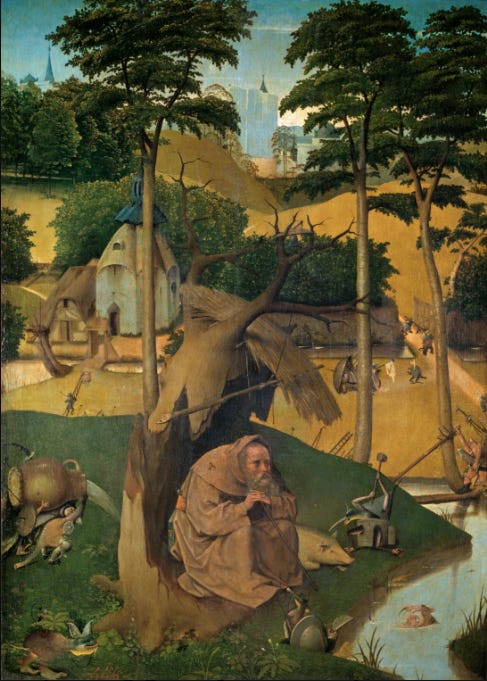
Every few months I find myself thinking about this passage from the Brian Catling Hollow, about a detail in the painting The Temptation of Saint Anthony, by Hieronymus Bosch:
Just before he left, Benedict turned back to scrutinize the detail Dominic had seen in this “gentle” painting, and there it was. Squeezed into a tiny gap between the hollow tree and the bottom right-hand corner of the church—a tiny bright light, a glow of fire. Compositionally, it flickered between the blind side of the church and the woodland behind it. But in the flattened perspective of the painting, the fire also sat just beneath the dry sheaf of straw, which was threaded through the desiccated tree to give shade to the saint below. This one brushstroke undid the apparent peace of the picture and made it a tinderbox of tension. It was the moment before the total conflagration that would devour the entire landscape and turn its gentleness into ash.
Benedict understood enough about painting to know that such a bright detail would have been added last. If this really was the artist’s final work, then he was now staring at the essence of a vision, a signing in time. One tiny stroke, a lick of paint. A sable flame.


I posted the above to bluesky once and Laurent Carbonneau replied with this quote, from the novel Dæmonomania by John Crowley, about Giuseppe Arcimboldo’s portrait of Holy Roman Emperor Rudolf II as the Roman god Vertumnus:
The figure’s toga, of spring and summer flowers and sweet lettuces, revealed the bosom, a great autumn gourd; warty winter roots were the tendons of his neck, and a bristling chestnut the beard beneath his lip. In his lip, June raspberries; peas in their pods his eyebrows; sheaves of wheat and grapes, blushing apples his apple cheeks, the Emperor laughed aloud in gratitude and glee. How many portraits of himself had his artists made over the years, endowed with his chains of office, his Roman armor and bays, with the sacred Cross; surrounded by Fame, Victory, Justice, Orthodoxy. No: here he was of the earth only, a man composed of Earth’s multiple and constant production in time; himself, and yet not himself but all things, beyond all the powers of kings and states, popes and principalities, changeless in constant change.

Anyway, I don’t really have a point. Just ran out of time to write a full newsletter this week. Do you you have a favourite piece of ekphrastic writing? Let me know in the comments, I guess.
Instagram | Goodreads | Letterboxd
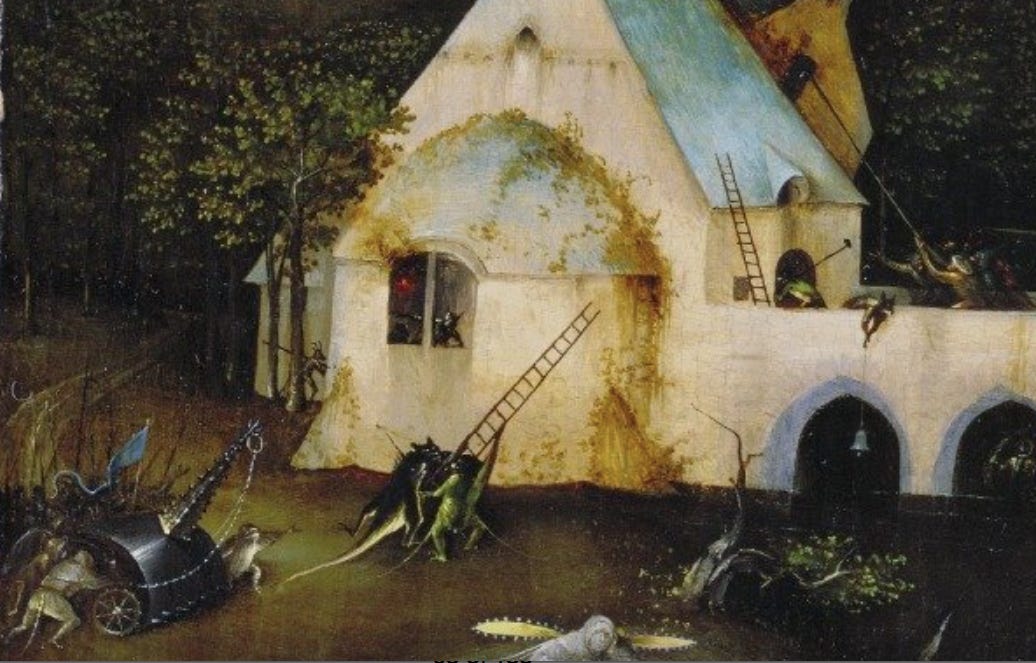
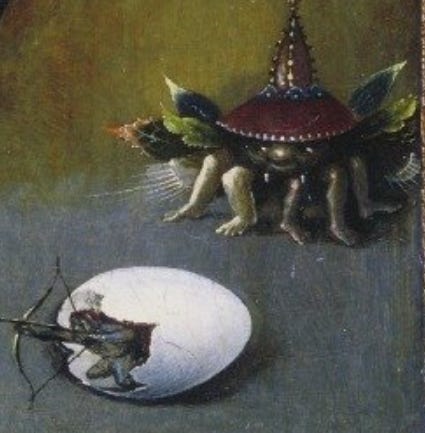
Oh, and check out this neat variation, a Temptation of Saint Anthony by a follower of Bosch that’s apparently held in the National Gallery of Canada that I stumbled on as I was about to schedule this post.

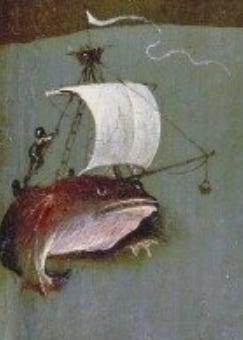
I like the nighttime setting, the lizard men soldiers, and the sailing frog.
I guess you could call the opening of my essay on Mantegna's The Court Scene from La Camera degli Sposi a form of ekphrasis, where I've fictionalized a trivial moment in the fresco.
I don't think John Barth could write any fiction that wasn't in that style- at least that was the impression I got from reading his short stories.