


Gormont et Isembart, a neglected medieval epic
Adam's Notes for November 28, 2023


This week I want to talk about Gormont et Isembart1, one of the earliest surviving chansons de geste. Written sometime between 1068 and 1150, it is very loose re-imagining of the Battle of Saucourt-en-Vimeu, in 881, a victory for King Louis III of France against the Vikings, in which the Annals of Fulda tell us some 9,000 Vikings were slain.
In the poem, King Louis III becomes a character more familiar to the audiences of the gestes: Louis the Pious, Charlemagne’s son and heir. In the tradition of the chansons de geste, Louis the Pious is something of a fallen king. He is competent, wise, and strong in battle, but lacks the greatness of his father, stays out of battles until the last minute, and often refuses to come to his vassals’ aid. Isembart seems to be a wholly fictional character. He is a knight who, insulted by his king, defects from the Christian camp and renounces Christianity to serve King Gormont. It is possible, but I think unlikely, that Isembart is a memory of Pepin II of Aquitaine, a minor King who allied with and went over to the Vikings, and was said to have renounced Christianity and taken their religion.
The character of Gormont is based on the Viking King Guthrum, a leader of the Great Summer Army that joined with the Great Heathen Army to invade large swathes of England in 872. Guthrum was defeated by King Alfred the Great in 878 and forced to convert to Christianity. The Treaty Between Alfred and Guthrum is seen as the foundation of the Danelaw, the area of England where Danes held sway. Guthrum never left England to raid France, but he organized and supported a large army that did. None of this is relevant to the poem, though. It just takes his name and sets the battle in the same area. At one point Gormont’s domain is said to be in England, though elsewhere he is described at least once as an Arab, and more often as a Moor or a Saracen. I’m not sure if this means the poet thought Gormont was a Muslim, or, more likely, if the word Saracen at that point was a catchall term for all non-Christians (aside from Jews).
Aside from being one of the oldest chansons de geste, Gormont at Isembart is also one of the most fragmented: only 661 lines of it survive.
The surviving fragment begins at the poem’s climax, the epic battle between the Saracen King Gormont against the French forces. Luckily, there are callbacks within the poem that help us figure out some of what happened previously. We can also infer the details from two later sources: the 13th-century rhymed chronicle of Philippe Mouskes offers a summary of the story, and the 15th-century Lohier et Mallart reuses material from the story.
Gormont et Isembart has been translated into English by Michael Newth, and is available in his book Heroes of the French Epic. He helpfully divides the poem into six episodes. Let’s take a look.
Episode 1: Gormont’s Stand. Beginning in media res, Gormont is attacked but emerges victorious in a series of one-on-one duels in the middle of a battle. Gormont, on foot, is struck with a lance by Walter Mans, who is fighting on horseback. Gormont kills Mans and an unnamed German soldier with a single throw of his javelin. Thierry of Terms strikes Gormont, again from horseback, but is killed by Gormont’s sword. The count of Flanders is killed by a second javelin2 thrown by Gormont. The knight Eudon strikes with his sword Kolane and would have killed Gormont, except that one of Gormont’s Irish soldiers leaps in and injures Eudon’s horse. Gormont attacks, but this time his javelin misses and Eudon escapes. Next Gormont cleaves the count of Poitou ‘from brow to belt.’ Gormont hurls another javelin which hits a Norman count, bursts out of his back and continues on to kill a Lombard lad. Each victory ends with Gormont boasting against the Franks and the Christians. Finally Ernault of Pointheu drives his spear through Gormont’s ribs and announces that he owns this land and owes fealty to no one but God and King Louis. Gormont commends Ernault’s blow but then kills Ernault with a sword blow to the head, saying they’ll die together. Gormont mocks Ernault for believing in Christ, “Do you still think He rose on High / And has the power to save your life? / What kind of help can He provide / Who could not save His own poor hide? / By good Apollo, like you, He died!" Just then, the knight Hugh arrives and begs King Louis to be allowed to join the fight, but Louis is reluctant: Hugh is his last living friend, and Louis doesn’t want to lose him.
Episode 2: Hugh’s Challenge. Hugh makes his case for joining the fight, and though King Louis grabs at the reins of Hugh’s horse, Hugh rides off and joins the battle. He smotes Gormont’s helmet so hard that Gormont drops to all fours, his Pagan troops rushing in to break up the fight. Hugh introduces himself to Gormont and makes a strange announcement relating to an earlier, lost incident in the poem: “Sir Hugh it is who’s stopped you short– / The same man who you’ve seen before, / Inside your camp in Louis’ cause; / In maiden’s dress your meal I brought– / A peacock served upon a board: / But something shocked and locked your jaws!” Gormont replies that ‘all is fair in war,’ including, evidently, Hugh’s crossdressing disguise. Gormont promises to kill Hugh now, then says that he actually recognized Hugh at the time, but his jaw became locked by some magic of Hugh’s, and Hugh escaped by stealing Isembart’s best destrier (war horse). No doctor will be able to heal the wound Gormont wants to give Hugh. Hugh says Gormont’s words are mere wind. Again an Irish knave attacks, but Hugh strikes him dead. Hugh charges at and wounds Gormont, but Gormont’s counterattack sends Hugh tumbling from his horse. Now the rebel knight Isembart joins the fray, and both he and Hugh chase after Hugh’s horse on foot. Hugh captures and remounts the horse, but is killed while scattering a group of archers, crossbowmen, and other soldiers. Hugh’s squire and nephew Young Gontier witnesses this and is enraged. Hugh armed him as a knight only a week ago. While attacking, Young Gontier tells Gormont that he was at Hugh’s side when they infiltrated his camp. Not only that, but he stole a gold cup, which he has since dedicated to the shrine of Saint Riquier as recompense for Gormont setting St. Riquier’s fine church on fire. But Gormont doesn’t care. He dismisses Young Gontier, he will not joust against a mere squire.
Episode three: Gormont’s death. King Louis, seeing the carnage of the battlefield, chastises himself for not averting the war by challenging Gormont to a one-on-one duel. After all, they are both kings and so of an equal class. Louis prays to the saints for their assistance, promising to rebuild and expand Saint Riquier’s church. King Louis enters the fray and kills Gormont with a headstrike that cleaves Gormont down the middle like in a Looney Tunes cartoon. Louis drops his pike after the blow, and the effort of bending down from his saddle to retrieve it bursts his lungs. The poet tells us King Louis will die within thirty days and praises Louis’s noble blood, battlefield bravery, and wisdom. “The song says this, and it’s correct: / No lawful heir’s ruled France since then.” Seeing their king dead, Gormont’s Moors panic and flee for the port. The rebel knight Isembart swoons three times over Gormont’s corpse, lamenting a prophecy from a lost section of the poem predicting that he would be caught or lose his life if he were to join Gormont’s cause.
Episode four: Isembart’s Stand. The battle has now raged for three days, but finally Gormont’s army is in retreat. Isembart chastises the Pagans for their cowardice. He reminds them that they have no kin in this land, so there’s nowhere safe to retreat to. Instead they should follow Isembart into battle, but they refuse. Isembart kills Seguin, a cousin to King Louis. Racing across the field, Isembart again encounters Gormont’s bloody corpse, its mouth agape. He issues another lament, saying that he twice warned Gormont about the prowess of French troops: once in Gormont’s domain of Cirencester, and again while they were at sea. Isembart praises Louis, but says now he must lead the remainder of Gormont’s army. Finally the Moors and Pagans (the terms are interchangeable terms for Gormont’s troops, and there are also mentions of Saracens and Irish knaves) rally and follow Isembart, who reminds them that they are in a foreign country and that following Gormont brought them riches. Isembart promises not to fail his troops.
Episode five: Louis’ noblesse. The battle continues for four more days. Isembart leads forty thousand Moors against the best of King Louis’s ten thousand remaining knights. King Louis finds the body of Gormont on the crest of a hill, and laments that if only Gormont had been a Christian, there would have been no better man. King Louis takes the body back to his tent. He also finds Young Gontier weeping over the body of Count Hugh, and together they wrap Hugh’s body in fur and set it upon a stallion. King Louis himself takes the rings of the horse. Hugh’s body is also brought back to the tent.
Episode six: Isembart’s death. On the battlefield, Isembart is about to kill Miles the Sturdy when Bernart—Isembart’s own father—splits Isembart’s shield with a single strike. Isembart then splits Bernart’s buckler and damages the chainmail of Bernart’s armour, a blow that forces Bernart to dismount his horse, though Bernart himself is not wounded. Isembart steals his father’s horse and the poet tells us it was a sin for Isembart to strike his father, but neither recognized the other. If they had, Bernart would have tried to speak with Isembart, we’re told. The Pagan troops accuse Isembart of foreswearing them, just as Isembart foreswore his Christian faith. Isembart curses them and tells them to fight on. Finally, the Pagan troops scatter and flee to their ships. Some are cut down by the French but some seem to make it. Isembart fights on with only two thousand troops until finally he is attacked by four Frenchmen: three counts and a duke, all unnamed. They deal him three grievous wounds and hack him from his horse, but leave him to continue the rout of the Saracens. Isembart slumps over in a glade near a crossroads where three paths meet. He calls upon the Virgin Mary, and recalls that fortune tellers among the Pagan Moors told him he would be captured or slain if he returned to France. He prays to Jesus, “Forgive them, Lord, those barons brave / Who’ve slaughtered me for Your love’s sake!” Then he prays again to the Virgin Mary, “Please ask your Son to show his grace, / Upon this lamb that went astray.” Isembart lays upon the grass of May (a symbol of war, because in May the grass is tall enough that horses can be put to pasture on campaign with no need for knights to bring fodder). Up ahead he sees an olive tree “well-leafed for shade” (an obvious symbol of peace). He struggles towards it but dies in the process.
So that’s Gormont et Isembart. I think it demonstrates a lot of what’s great about the chansons de geste. There’s none of this grail quest stuff like in Arthur. It’s all jousting and knights hitting each other over the head with swords.
And yet there’s still plenty to chew on. We tend to think of medieval folk as uncritical Christians, yet so much of the poem is Gormont mocking the Christian faith, and Isembart renounces it. Yeah, sure, Gormont’s the villain and Isembart repents, but someone had to sit down and write those lines, you know? And the conception of the Other: Irish, the English town of Cirencester, Arab, Moor, Saracen, Pagan, Apollo. All terms used to designate the foreignness of Gormont’s army. Who did the poet think these guys were?
But of course the most interesting part is all of the poem that’s missing. What was going on in that cross dressing episode? What was the nature of the conflict that made Isembart leave France and renounce Christianity? Did he kill someone by striking them in the head with a chessboard, a recurring trope which gets Ogier and Renaud into trouble in their gestes? Or was it something totally novel, like when Girart de Vienne rebels against Charlemagne after he’s tricked into kissing the queen’s foot? More than anything, I really hope there’s some book out there with the rest of this story in it.
Yet if we don’t know this story’s past, we know it’s future. A lot of these plot elements get developed in future gestes: the unknowing battle between father and son, King Louis’ reluctance to take action, the uncle-nephew pairing in which one seeks revenge after the other is slain.
Which reminds me, I was reading a paper3 that said Philippe Mousket’s 13th-century Rhymed Chronicle, which offers a summary of Gormont et Isembart as part of its narrative of French history, throws in an episode absent in the version we looked at today. In that version, it’s said that the battle would have been lost by the French except for the women of the town, who join in the fight on the side of the French. Wild.
Pepys Show
The second half of November 1660 starts with Pepys at a dinner with his cousin/patron, Lord Montagu. He brings his wife Elizabeth with him, and she’s able to help Montagu’s wife, Jemima Montagu (who Pepys always affectionately refers to as ‘My Lady’), speak with her new French servant. Pepys notes with pride that this is the first time Lord Montagu has taken notice of his wife, which is interesting because, as Claire Tomalin notes in her biography of Pepys, Samuel Pepys and Elizabeth were married when Pepys was still in the direct employ of Montagu, living in the Montagu lodgings at Whitehall, in an attic Pepys referred to as his Turret. The implication being that Pepys kept his marriage a secret from his patron, at least at first, even though Elizabeth was living with him in the Turret.
His marriage was one of the few things Pepys did for love instead of money, not that it mattered. He cheated on Elizabeth frequently, often with their household maids, and he became jealous when men took an interest in her, which they sometimes did. Including Lord Montagu, once. They had at least one big fight before the diary commenced and another in the diary’s final year, when Samuel Pepys woke up at about one AM to find, “she come to my side of the bed, and drew my curtaine open, and with the tongs red hot at the ends, made as if she did design to pinch me with them, at which, in dismay, I rose up, and with a few words she laid them down; and did by little and little, very sillily, let all the discourse fall; and about two, but with much seeming difficulty, come to bed, and there lay well all night, and long in bed talking together, with much pleasure, it being, I know, nothing but her doubt of my going out yesterday, without telling her of my going, which did vex her, poor wretch! last night, and I cannot blame her jealousy, though it do vex me to the heart.”
But the back half of November 1660 was a good time for their marriage. On the 18th, Elizabeth joins him in their new church pew for the first time. The next day, Pepys brings home two new paintings, but Mrs. Pepys doesn’t like them, so he sends one back. He calls it a picture of Paris, and I can’t help but wonder if he means the character from Greek myth, because Elizabeth is the daughter of a Huguenot and she enjoys French books and most things Catholic, so I find it hard to imagine she’d reject a landscape painting of Paris, but who knows? On the 20th he makes a point of noting when his wife came to bed (around two AM, after the maid had finished the month’s wash, on the first frost of the year), and that evening he manages to score an invitation for him and Elizabeth to dine with the Queen and the princesses, who’ve just returned from nineteen years of exile in Europe.
The audience with the Queen is on the 22nd. Pepys compliments Elizabeth in his description of the royals: “The Queen a very little plain old woman, and nothing more in her presence in any respect nor garb than any ordinary woman. The Princess of Orange I had often seen before. The Princess Henrietta is very pretty, but much below my expectation; and her dressing of herself with her hair frized short up to her ears, did make her seem so much the less to me. But my wife standing near her with two or three black patches on, and well dressed, did seem to me much handsomer than she.”
After that, life gets quotidian again:
On the 27th, Pepys gets caught in a traffic jam after a draymen (a guy operating a small, flatbed cart) kills one of the footmen of Lord Chesterfield. There are no further details, but I like to imagine it as a case of road rage.
On November 28th4, Pepys gets a hefty payment when a regiment he’d held a sinecure with is disbanded.
On November 29, “a great deal of foul water” floods Pepys’ parlour from under the partition between him and his neighbour, Mr. Davis, a junior clerk in the navy. Pepys recently had some workers building a new door onto his house, and he sends for them only to find they’re busy at Mr. Davis’. Mr. Davis argues his case but relents and sends the workers over, but also announces that thieves attempted to burgle his house the night before, “which do make us all afraid.”
That’s it for November. Next month: Parliament dismembers the corpse of Oliver Cromwell and friends! A plot against the King is foiled! Pepys repaints his house! Then in January, a band of fanatiques threaten London and Pepys himself goes out armed with sword and pistol.
By the way, if you’re enjoying my reading of Samuel Pepys diary, you might enjoy my short story “Diary of the Wolf” due to be published in issue six of Old Moon Quarterly out in January 2024. It’s a werewolf story set in March of 1660, riffing on the diary.
Old Moon Quarterly is a new genre magazine featuring dark fantasy and sword and sorcery stories that “read like an Albrecht Dürer etching if Dürer read too much Warhammer.” They’re down to the final hours of their Kickstarter campaign raising funds for issues seven and eight, and if that sounds like your kind of thing, you can check it out here.
Links
Medieval insults. Shared this with someone who remarked, “Rotten Donkey and Mad Boy sound like reggaeton or grime artists.”
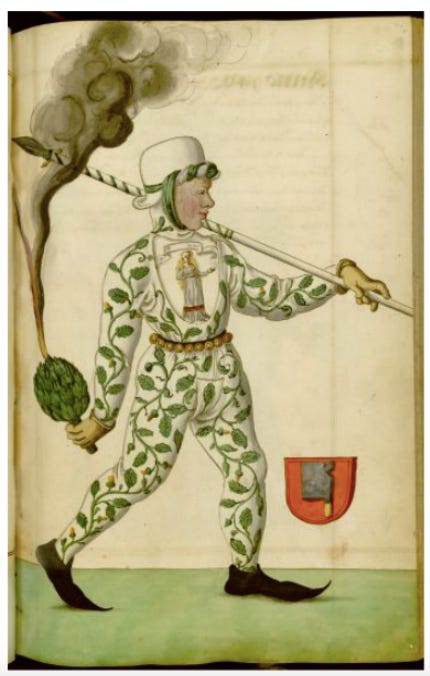
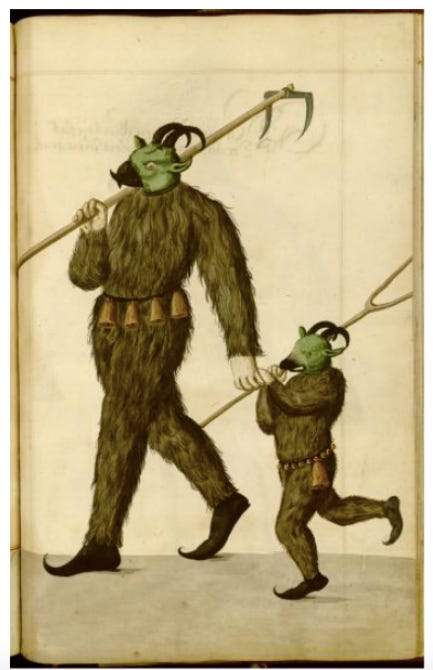
Radical Fashion from the Schembart Carnival (1590). I’m pretty sure the pig man is wearing a coat made of sausages.
Scrub-a-Dub in a Medieval Tub. JSTOR Daily article going through all the old “did medieval people bathe?” stuff, but includes nice pieces on the Melusine legend and Charlemagne’s love of swimming. “In Vita Karoli Magni (Life of Charlemagne), the ninth century Frankish scholar Einhard observed that Charlemagne invited his sons and friends to join him in a pool-like bath. Members of his court as well as soldiers were likewise welcome, and at times, more than a hundred men bathed together. Indeed, baths with spacious pools were an important feature of Charlemagne’s palace in Aachen. Their thermal complex, Aquae Granni (“Waters of Grannus,” a reference to a Celtic healing god associated with medicinal springs), existed since the Roman era and inspired the later Latin name of the city: Aquisgranum.” No mention though of Notker the Stammerer’s anecdote about Charlemagne’s father’s encounter with a demon in the pools of Aachen.
Also of note: Chapo Trap House has started releasing episodes of Matt “Cushbomb” Christman’s four part series on the Spanish Civil War, recorded before his health issue forced him to step back from the show. Get well soon, Matt. The Spanish Civil War is one of my other favourite historical subjects, one I hope to dive into here, eventually. In the meantime, check out one of my favourite websites, on Canada and the Spanish Civil War.
Well, that’s all for now. Thanks for reading, especially if you’ve made it this far. This has been Adam’s Notes for November 28, 2023. My name is Adam McPhee, and you can find me on Twitter, Bluesky, Letterboxd, and Goodreads.
Blue Sky invitations:
bsky-social-g7koc-nh4cb
bsky-social-fgtxo-nrxy7
Also known as Gormond et Isembart, Gormund et Isembard, etc. These poems don’t have consistent spellings even within a poem. Tense, likewise, can shift around at whim.
Newth uses the term ‘wyvern-dart,’ which I assume is just a poetic term for a javelin. The Franks used a type of javelin called an angon, similar to a Roman pilum. Both very neat weapons that, sadly, don’t get used in movies. Though Guy Halsall figures the angon would’ve fallen out of use in the 7th century. https://en.wikipedia.org/wiki/Angon
A Note on the Amazons in Anseÿs de Mes by Alfred Adler. https://www.jstor.org/stable/2908724
Ahem, my birthday, as it happens.
I'm sure I've read something about vikings and Muslims/Saracens getting conflated in the later medieval sources, but for the life of me I can't remember where it was or who it was by. I'll wrack my brain and let you know if I come up with anything.