
A few late winter reading recommendations
Adam's Notes for February 26, 2026

About Me | Instagram | Goodreads | Letterboxd
There’s some ad playing on Youtube that keeps using that one song by The Killers, and I keep mishearing the line in my head as “Are we human/Or dare we answer?” Quite frankly, I think my version is better. More philosophical, with a hint of some kind of cosmic dread. WTF is “are we dancer” even supposed to mean? It’s stupid. Anyway, here are four books I’ve read recently, there’s no real theme, although two of them have the word blood in the title:
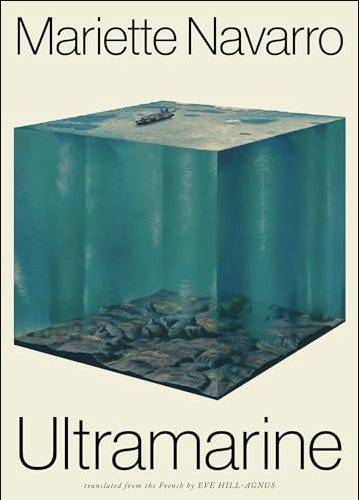
Ultramarine by Mariette Navarro
Translated from the French by Eve Hill-Agnus
Deep Vellum, 2025; 159 pages.
Eerie. Mesmerizing. Hypnotic.
A woman captain of an otherwise all male crew on a transatlantic cargo ship allows the crew to use their downtime to go swimming in the ocean. The roll call afterwards is disturbing: somehow they’ve picked up an extra crew member, and they can’t figure out who it is. From there, strange things begin to happen.
I understand that something like this shouldn’t have a straightforward explanation, but I still feel like a lack of closure kept this at good, instead of being great. Although that’s the nature of a haunting, isn’t it? That eerie feeling that something is left incomplete. I won’t ruin it by saying anything more. Don’t skip this extremely atmospheric novel.
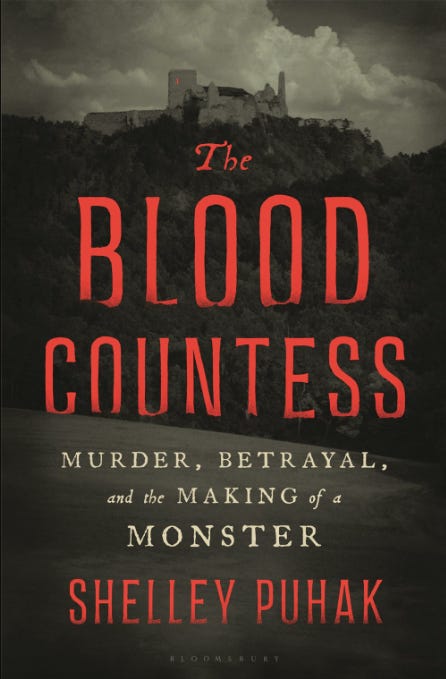
The Blood Countess: Murder, Betrayal, and the Making of a Monster by Shelley Puhak
Bloomsbury, 2026; 304 pages
A book that uses the Bathory legend to jump into the history of Hungary. It's a complicated subject matter, without any familiar names or faces to help guide us along, but Puhak does a fantastic job of untangling the murky history and providing context. She has no time for the salacious and bloodthirsty legend, showing that there was no way it could be true (the girls’ school Bathory sponsored and was said to have preyed upon would’ve had to be wiped out completely three times over), and was instead a product of the campaign of slander carried out by her enemies. The problem is that the Bathory legend is fun, and a lot easier to understand than what actually happened.
Still, he geopolitics of 1600s Hungary ends up being interesting in its own way: you’ve got Catholics, Lutherans, and Calvinists all wary of each other, in a sort of permanent paranoia about the Ottomans at their doorstep. I really liked the stuff about the Hajduk, the bandits who haunt the hillsides and at one point are organized into an army.
Bathory comes off as a skilled administrator, adept at using the legal system to her advantage (until it all comes crashing down), and Puhak’s overall literary project seems to be to prove that a woman in this sort of role is not as uncommon as history would have us believe. The book was a great read, but if you haven’t read Puhak yet, I’d recommend starting with her earlier work Dark Queens, which is more accessible.
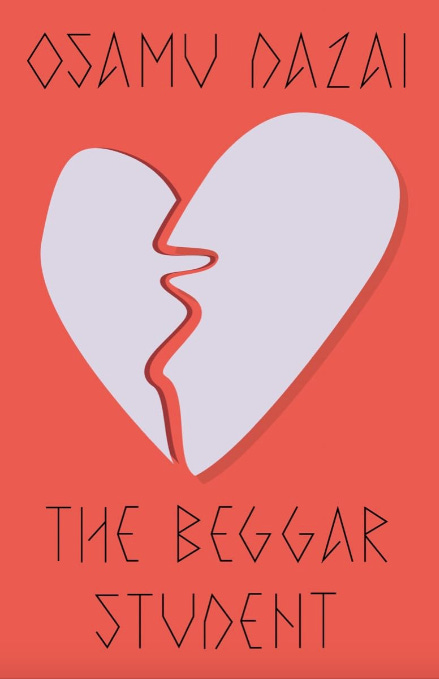
The Beggar Student by Osamu Dazai
Translated from the Japanese by Sam Bett
New Directions, 2024; 73 pages.
A Japanese novel written in 1940, but only translated recently. Francois Villon—one of my favourite French rascals—gets mentioned in all the reviews, and there is a definite connection to him in the book, but think I set my hopes too high. It goes for a sort of madcap energy but doesn’t always get there, although it is funny at times.
So, a thirty-two year old writer drops off his latest manuscript in a mailbox, admitting it’s garbage and that he’s phoned it in. On his way home, he sees a boy in a river who he thinks is drowning, the boy turns out to be a high school dropout. They get into a sort of battle of wits, and he takes the kid to a nearby teahouse. The boy convinces him to take his place as a benshi, a narrator of a silent film. To do this, the narrator will need a school uniform, and they manage to borrow one from the novel’s third character, the boy’s former classmate. Obviously the uniform barely fits the adult novelist and there’s some humour wrung out of that. There’s a knife fight and drinking and eventually a cop stops them and asks what school they belong to—an obvious problem for our protagonist, who takes off running. The scenarios are clearly set up for humour, but didn’t quite work for me in their execution. Apparently it’s thought to be somewhat autobiographical, as wikipedia says the setting of the novel is where Dazai would attempt suicide for the fifth and final time in 1948. Lincoln Michel had an interview with the author that I thought was interesting, even though I didn’t really care for the book:

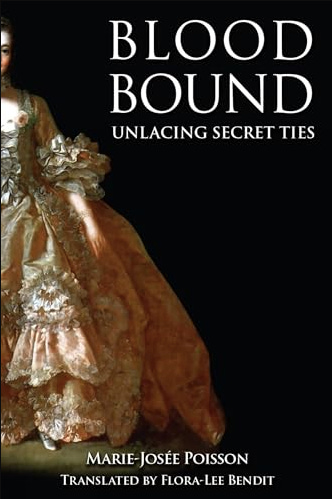
Blood Bound: Unlacing Secret Ties by Marie-Josée Poisson
Translated from the French by Flora-Lee Bendit
Guernica Editions, 2026; 240 pages
Lou Ashby has it pretty good: she’s equally at home in the cities of Montreal and Paris, and she even knows her way around the more fashionable parts of rural Quebec. She’s very stylish, fashionable, and has a good job at the Montreal outlet of an international Francophone television company. Her best friend, a gay Labradorian dancer, is about to have a successful launch of a ballet project. There’s one problem: her last name isn’t Ashby, it’s Poisson, as in fish, and her extreme bully of a boss (an unfashionable feminist and separatist—boo! hiss!) uses that to humiliate her at a company dinner.
Soon she finds out she may have a connection to another famous Poisson: Madame de Pompadour, the chief mistress of King Louis XV, born Jeanne Antoinette Poisson. When a blood-soaked dress is recovered from the walls of the Élysée Palace (once Madame de Pompadour’s residence), Lou is unknowingly drawn into a mystery that will rewrite the history of 18th-century Paris and New France.
There’s a certain confidence to the prose that I really enjoyed, one that I feel used to be a bit more common, but was lost—maybe the recent trend towards more experimental fiction doesn’t allow it? I don’t know.
The book has received comparisons to The Da Vinci Code. There’s a similar premise, and our mystery here unfolds by learning about genealogy and costume studies the way Dan Brown used art history (I think but can’t say for sure that Blood Bound was first published in French at around the same time), yet I think a better comparison would be with Stieg Larsson’s The Girl with the Dragon Tattoo series. Both Girl and Blood Bound have an obsession with what’s fashionable and what’s not, and both seem to involve their authors dreaming about a more fulfilling career.
Somehow, I was halfway through the book when I realized there was a third Poisson (a whole school of them, if you want a fish joke), this being the author, who, like Lou, is also a former Quebec television executive. So yes, I think there’s more than a bit of wish fulfillment in Blood Bound, but it’s of such an idiosyncratic nature that I couldn’t help but forgive it that—I was having too much fun. And besides, wish fulfillment was a big part of Stieg Larsson’s project, too, and you wouldn’t want it any other way.
More Books:
A brilliant comic book and two war stories: Hobtown Mysteries, The Fort Bragg Cartel, and The German Prisoner
10 Things I Learned About the Bronze Age from The Horse, The Wheel, and Language
Journeys to Renaissance Italy… And Yorkshire: Florenzer, Romola, The Throne, Perspective(s), A God in Need of Help, and The Gallows Pole
Two sophisticated novels for adults, and one with dinosaurs: Audition, Good Will Come from the Sea, and Adam & Eve in Paradise
Summer reading roundup: The Midnight Project by Christy Climenhage; Bodies of Summer by Martin Felipe Castagnet; The Wheelman by Duane Swierczynski
Eurotrash by Christian Kracht and Perfection by Vincenzo Latronico
Permafrost by Eva Baltasar and The Private Lives of Trees by Alejandro Zamba
Adam, reading your Substack is getting expensive - I keep ordering books you've mentioned. (I do check the library first, which helps a bit.)